
IS IT AI?

TEKWITCH believes in harm reduction, not purity tests. The following labels exist to help users make informed choices about how they pursue their own ends.

NO AI NEEDED

Using these products does not require an AI.

AI OPTIONAL

Using these products can involve at least one optional feature that relies on some form of local machine learning; no data center involved.

AI PAYLOAD

This dependency is itself a trained machine-learning model or a packaged representation of one.

AI NATIVE

These products are designed to operate inside existing AI systems, specifically for the purposes of reducing one or more negative aspects of AI adoption: misuse, overuse, inference waste, and/or infrastructure bloat.

AI INVOLVED

These products were developed through a process in which TEKWITCH chose to incorporate at least one artistic or creative step powered by some form of machine learning.

TEKWITCH

WAYHAND

Keep the authority. Replace the machinery.

Wayhand is a proposed AI-enabled computing system whose purposes and consequential actions remain accountable to a real human—even when the model, operating system, provider, or machine changes.

AI NATIVE · WORK IN PROGRESS · AUTHORITY · RECOVERY · PROOF

SHARE THIS ↗

THE PROBLEM

The work is yours. The system may not be.

Imagine a long project that depends on an AI assistant.

It can find your notes, help organize decisions, and use connected tools to change files or send messages. Then you change providers—or a service changes underneath you.

You may have your conversations, but can you reconstruct the working setup: the history it needs, the tools it can use, the permissions you've given, and the limits you've set?

And there's a second problem: having a tool that can act does not mean an AI should be able to decide when to use it.

THE PREMISE

A system that answers to its person.

A computer can become more capable without taking its person's decisions away.

WHAT
A proposed personal computing system that can retain its identity while its software and models change.
WHY
Its purpose, permissions and useful history should survive dependency failures and replacements.
WHO
An actual human remains the Authority for consequential decisions.
WHERE
Local hardware, with offline reasoning and recovery as design requirements.
WHEN
Still in development. The next step is proving its safeguards work on a real computer. A working Wayhand, and eventually a version others can set up for themselves, come later.

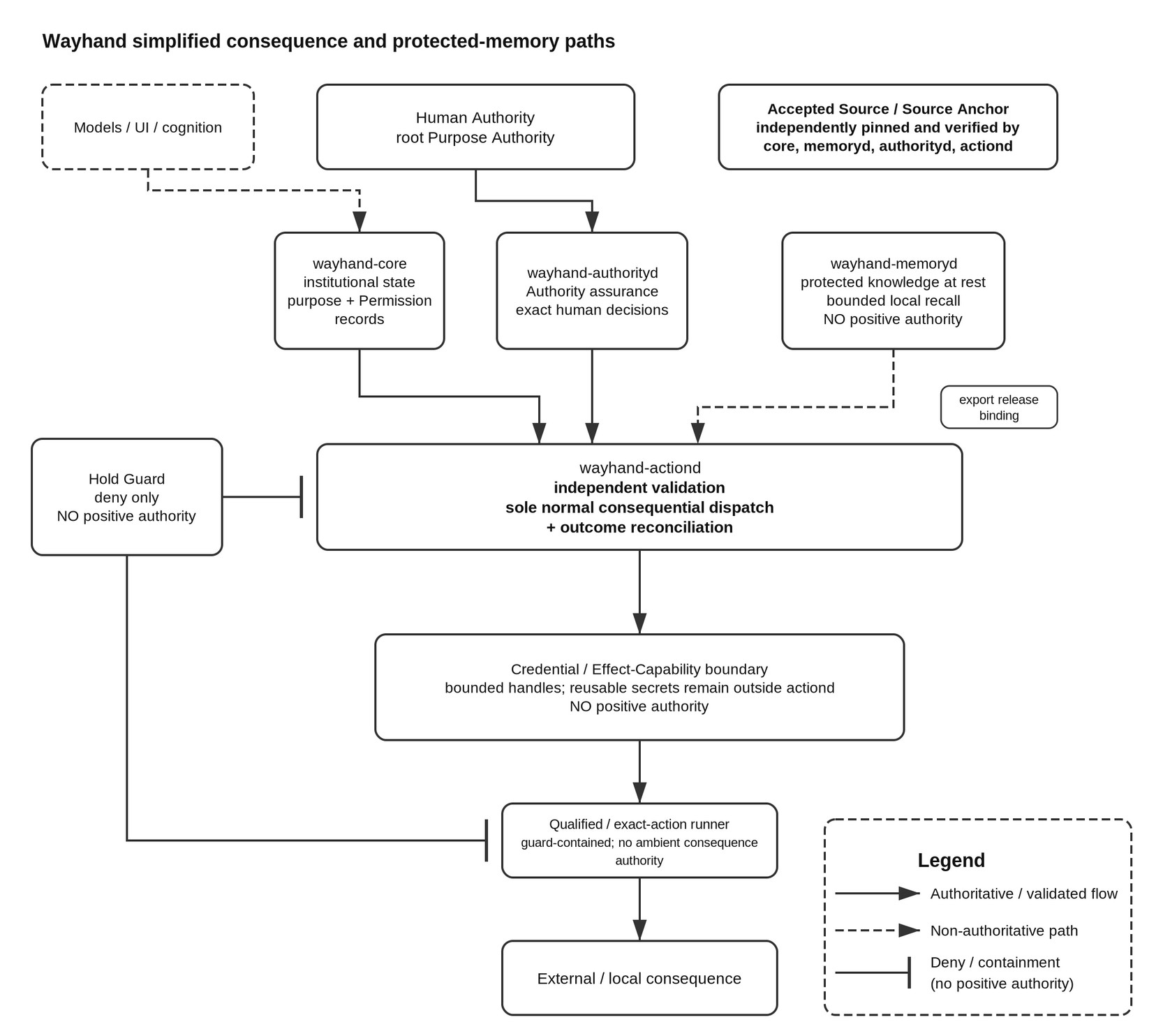
FIGURE 1 · THE WHITEPAPER

See the design.

Human decisions, protected memory, model proposals and external action follow separate paths. The paper explains the proposed safeguards.

Wayhand architecture diagram showing separate human Authority, reasoning, protected memory, deny-only Hold Guard, action validation and bounded effect capability.
Wayhand Figure 1. View full size.
READ THE DIAGRAM IN TEXT

Models propose actions but do not authorize them. The human is the Authority. The institutional core records purpose and permission; human assurance and protected memory have separate boundaries. The independent action checker validates an exact consequential request, the deny-only Hold Guard can block it, and a bounded capability reaches the runner. A local memory release is distinct from permission for external export.

READ THE PAPER

The whitepaper.

The full argument.

PUBLICATION CANDIDATE 0.3.12

Wayhand: A Human-Authority Architecture for Persistent, Replaceable AI-Enabled Computing

Read the proposed design, threats, comparison with existing work, and requirements for proof.

PROJECT ROADMAP · R-00 TO R-14

Where Wayhand stands.

A working Wayhand is still ahead. The roadmap shows the steps between here and there.

The groundwork is done. Now Wayhand has to prove it can work.

We have the design and a prepared development computer. The current step, R-02, is about making the boundaries between human decisions, memory, and actions hold up on a real machine.

After that comes giving Wayhand carefully controlled things to do, building its independence, and eventually making a Seed that another person can use. Those milestones are still ahead.

SUPPORT WAYHAND ↓

Completed groundwork Current work Still ahead

R-00–01Prepare COMPLETED
R-02Prove the safeguards CURRENT · NOT PASSED
R-03–07Build & testSTILL AHEAD
R-08First WayhandSTILL AHEAD
R-09–13Prove in useSTILL AHEAD
R-14Public SeedSTILL AHEAD
VIEW ALL 15 DEVELOPMENT STAGES (R-00–R-14)
  1. R-00 · Source and proof mapPASSED — Accepted source, Constitution and traceability.
  2. R-01 · Development-host baselinePASSED — Measured substrate and protected recovery/preparation.
  3. R-02 · Trusted substrateNOT PASSED — Separate authority, core, memory and action boundaries; source/hold/capability proof.
  4. R-03 · Harmless exact actionPENDING — End-to-end authorization and synthetic consequence slice.
  5. R-04 · Guarded action runnersPENDING — Bounded execution, credentials, outcome and compromise tests.
  6. R-05 · Memory and human controlPENDING — Protected memory, approvals, operator workload and UI.
  7. R-06 · Offline cognitionPENDING — Qualified local reasoning and replaceable model routes.
  8. R-07 · Safe self-engineeringPENDING — Untrusted-workshop quarantine, independent promotion tests and rollback.
  9. R-08 · First WayhandPENDING — Real germination, commissioning, Q0 and bounded engineering handoff.
  10. R-09 · Public Seed and recovery hardeningPENDING — Reproducible installation, restore and independent source/build evidence.
  11. R-10 · FederationPENDING — Relationship scopes, shared compute and non-contagion.
  12. R-11 · Integration convergencePENDING — Re-prove combined operation and early independent human tests.
  13. R-12 · Sustained Phase-1 usePENDING — Reliability, burden, recovery and dependency/exit evidence over time.
  14. R-13 · Phase-2 host transferPENDING — Same Wayhand on expanded hardware, subject to accepted host plan.
  15. R-14 · Independently reconstructable Public SeedPENDING — Qualified commodity hardware, fresh ordinary strangers, full proof and terminal release decision.

SUPPORT WAYHAND

What would move it forward?

Specific resources make specific work possible.

Each ask identifies something useful, how it helps, and where to offer it.

FINANCIAL SUPPORT

Sponsor development

THE ASK Propose a defined financial sponsorship for equipment, storage, tool usage, or specific testing costs.

HOW IT HELPS Funds an agreed development need with its scope and terms discussed directly.

Can you provide it?

EQUIPMENT ACCESS

Provide a high-memory computer

THE ASK Offer a loan, evaluation unit, used host, or sponsorship toward a 192 GB-class system.

HOW IT HELPS Enables larger local model benchmarks and the eventual high-memory host transfer.

Can you provide it?

STORAGE AND RECOVERY

Provide suitable storage

THE ASK Offer a 4 TB system NVMe, 8 TB archive NVMe, or appropriate recovery media.

HOW IT HELPS Supports local project archives, recovery work and future host capacity.

Can you provide it?

COMPUTE / TOOL CREDITS

Provide usable compute or tool credits

THE ASK Offer bounded compute time, applicable development-tool credits, or eligible Work usage capacity.

HOW IT HELPS Permits more evaluation and engineering without immediately buying hardware or exhausting available usage.

Can you provide it?

FUTURE SEED TESTERS

Test a Seed when one exists

THE ASK Volunteer later for ordinary-stranger installation, recovery and reconstruction trials.

HOW IT HELPS Provides independent evidence that people unfamiliar with Wayhand can actually use its final Seed.

Can you provide it?

TEKWITCH LIVE

Join TEKWITCH on Twitch

THE ASK Follow the workshop, spend time with the community, and bring your curiosity.

HOW IT HELPS Builds the audience around the work and helps future collaborators and supporters find it.

Want to join in?